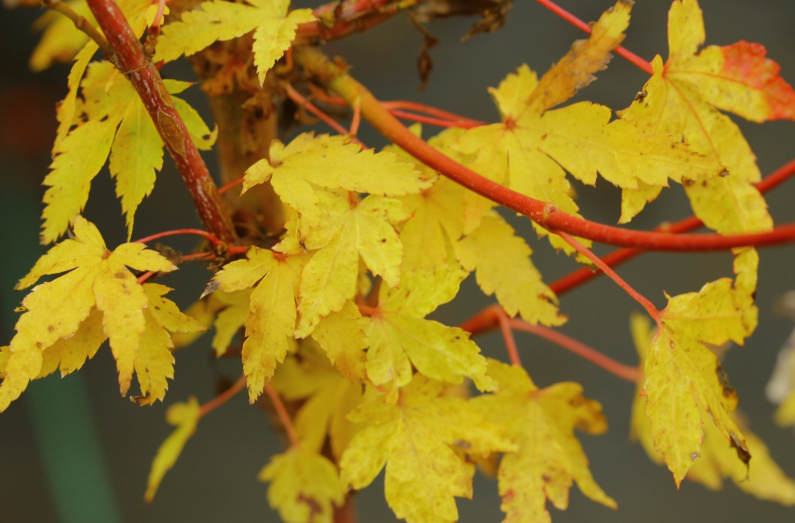
The coral bark maple tree is one of the few ornamental trees that people buy for how it looks in January rather than in May. Most flowering and foliage trees peak in spring or fall and then spend the winter as bare gray outlines. This tree turns that around. As temperatures drop and the leaves fall, its young branches turn a glowing coral-red, so a dormant tree reads as a flame of color against snow, evergreens, or a dull winter sky.
Sold under the cultivar name ‘Sango-kaku’, the coral bark maple is a selection of Japanese maple. It has become a staple in American gardens from the Pacific Northwest to the mid-Atlantic. It also changes through the seasons: chartreuse leaves edged in red in spring, soft green in summer, butter-yellow to apricot-gold in fall, and bright bark in winter. Homeowners who want a tree that holds interest for 12 months a year, instead of 2 or 3 weeks, often end up choosing this one.
Botanical Classification
The coral bark maple belongs to the maple genus, the large group of trees and shrubs known for opposite, lobed leaves and paired winged seeds. Botanists long placed maples in their own maple family. More recent classification moved them into the soapberry family, the same broad group that includes horse chestnuts and lychees. Within the maple genus, the coral bark maple is a cultivated variety of Japanese maple, a species native to Japan, Korea, and parts of China and eastern Russia.
‘Sango-kaku’ is a cultivar name, which means it marks a specific selected and propagated form rather than a wild population. You’ll also see it written as ‘Sangokaku’ or ‘Sango Kaku’. Older nursery catalogs sometimes list it under its former name, ‘Senkaki’. According to Rutgers University’s plant of the month profile, the name translates roughly to “coral tower”: “sango” means sea coral and “kaku” refers to upward growth. The name fits both the bark color and the tree’s upright, vase-like form.
Brief History
Japanese maples have been cultivated in Japan for centuries. Gardeners there have selected hundreds of forms for leaf shape, color, and growth habit, and many of these named selections were grown in temple gardens and private estates long before they reached the West. The coral bark maple comes from this long Japanese tradition of breeding maples as living art, prized for how they change through the year rather than for any single season.
Japanese maples first reached European gardens in the early 1800s and spread to North American nurseries over the following decades. The coral bark maple gained wide popularity in the second half of the 20th century, as gardeners and landscape designers paid more attention to “four-season interest,” the idea that a garden should still have structure and color in winter. The tree also earned the Royal Horticultural Society’s Award of Garden Merit, a recognition given to plants that perform reliably in ordinary garden conditions. Today it is one of the best-selling upright Japanese maples in the US, and it shows up regularly in university arboretums, botanical gardens, and residential landscapes.
Identifying Characteristics
The coral bark maple’s most recognizable feature is its bark. New stems and young branches are a vivid coral-pink to salmon-red, and the color deepens in cold weather. The brightest color appears on 1- and 2-year-old wood. As branches age and thicken, the bark slowly fades to a duller greenish-gray. Because of this, a well-grown tree shows its strongest color in the outer canopy, where new growth is constant.
The leaves are small and delicate, usually about 2 inches across, with 5 to 7 pointed, finely toothed lobes spread like the fingers of a hand. In spring they open pale yellow-green with red margins. They mature to a soft light green in summer, then turn yellow to golden-apricot in autumn. The leaf stalks often have red tones when grown in sun. Small reddish-purple flowers appear in mid-spring, usually around April. They are easy to miss but are followed by the paired winged seeds typical of all maples.
At maturity the coral bark maple usually reaches 20 to 25 feet tall and 15 to 20 feet wide, though many garden specimens stay smaller for decades. The University of Cambridge Botanic Garden describes it as able to grow either as a large multi-stemmed shrub or as a small tree of about 20 feet. Its habit is upright and vase-shaped when young, slowly broadening into a rounded crown with age. Growth is slow to moderate, often 1 to 2 feet per year in good conditions.
Landscape Uses
The coral bark maple is at its best where people can see it in winter. A common approach is to plant it outside a frequently used window, near the front entry, or where it can be seen from a kitchen or living room during the cold months. Placed against a dark backdrop, such as a hedge of evergreens, a dark-painted fence, or a brick wall, the coral stems stand out sharply. In snowy climates, red branches against white ground give some of the most striking winter scenes in American gardens.
Its modest size and fine texture make it a good specimen tree for small yards, courtyards, and foundation plantings, where a full-sized shade tree would overwhelm the space. It works well in Japanese-style gardens, woodland edges, and mixed borders, and it pairs naturally with underplantings of hellebores, hostas, ferns, and early bulbs such as snowdrops and crocus. Designers often group it with other winter-interest plants, like red-twig dogwood, witch hazel, and paperbark maple, to build a garden that peaks between December and March.
The coral bark maple also adapts well to large containers, especially while young. A potted specimen on a patio or deck can be moved to the most visible spot in winter. Container trees need extra protection in cold regions, though, because roots above ground are far more exposed to freezing than roots in the soil. The University of Florida’s Japanese maple fact sheet notes that Japanese maples suit use as specimen or accent trees near a deck or patio, in small spaces, and in Japanese-style gardens, which is exactly where this cultivar works best.
Growing Considerations
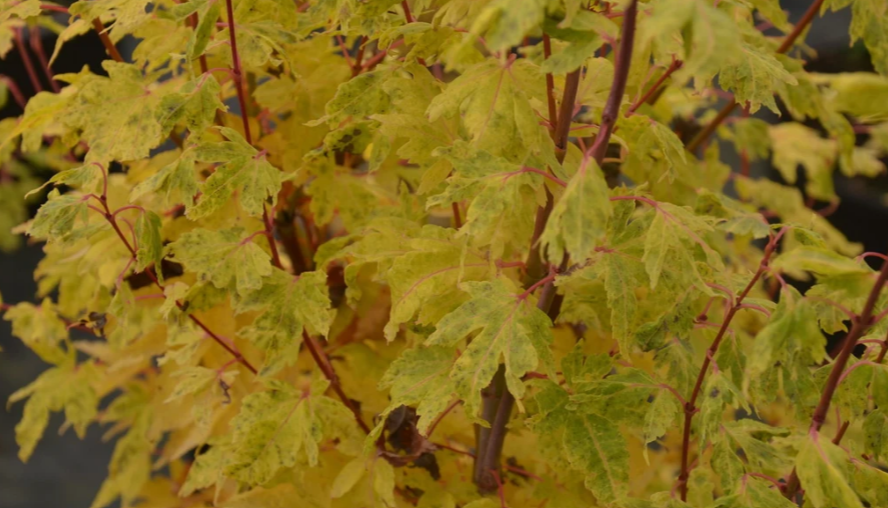
The coral bark maple grows best in roughly USDA hardiness zones 6 through 8. Gardeners in sheltered parts of zone 5 can often succeed with winter protection, and some growers in the cooler parts of zone 9 manage it with careful siting. Light is the key factor. In the Pacific Northwest and the northern states, the tree can take morning sun and some afternoon sun, and more sun generally means stronger bark color. In the Southeast, the Southwest, and other hot-summer regions, afternoon shade is essential. Without it, the thin leaves are prone to scorch, which shows up as brown, crispy edges by midsummer.
Soil should be moist but well drained, rich in organic matter, and slightly acidic, ideally around pH 5.5 to 6.5. Heavy clay that stays waterlogged is one of the most common causes of decline in Japanese maples, so gardeners with poor drainage often plant slightly high or in a raised bed. Set the root flare at or just above the soil surface. Planting too deep is a frequent and often fatal mistake. Spread 2 to 3 inches of shredded bark or leaf mulch over the root zone, keeping it several inches away from the trunk. Mulch holds moisture, keeps soil temperatures even, and protects the shallow, fibrous roots.
Watering matters most during the first 2 to 3 years after planting. A deep soaking about once a week, roughly 1 inch of water, is a sound baseline in most American climates. During heat waves and droughts, especially in sandy soils, water more often. Established trees handle short dry spells, but they look noticeably better with steady moisture. Fertilize lightly, if at all. Heavy nitrogen pushes soft, weak growth that is more prone to pests and winter damage, so a modest application of a balanced slow-release fertilizer in early spring is usually enough.
Pruning a coral bark maple is unusual in one respect: careful pruning actually improves the winter display. Because the brightest color is on young wood, removing a few older, faded branches every few years encourages fresh coral shoots. Prune during late-winter dormancy, when the branch structure is easy to see. Make clean cuts back to a bud or side branch, and avoid heavy shearing or topping, which ruins the tree’s natural form. NC State Extension’s plant profile describes the tree as a small to medium-sized deciduous tree, and light, selective thinning helps keep it in proportion with that scale.
Pests and diseases are usually minor in well-sited trees. Aphids and scale insects sometimes show up on new growth. Japanese beetles can chew foliage in the eastern US during summer. Verticillium wilt, a soil-borne fungal disease, is the most serious threat: it causes sudden wilting and dieback of individual branches, and there is no cure, so avoid planting where wilt-susceptible trees have died before. Late spring frosts can damage the tender new leaves after an early warm spell. Branch dieback from winter cold is more likely on young or stressed trees in the colder edge of its range. Oregon State University’s landscape plant database is a useful reference for comparing this cultivar with other Japanese maples before you buy, particularly if you’re deciding between several upright forms for the same spot.
With the right site, meaning dappled afternoon shade, good drainage, steady moisture, and a dark backdrop to show off its stems, the coral bark maple can live for many decades and become the main winter feature of the garden.
Sources
- Rutgers New Jersey Agricultural Experiment Station, “Plant of the Month: Coral Bark Japanese Maple”
- University of Florida IFAS Extension, “Japanese Maple” fact sheet (FPS009)
- NC State Extension Gardener Plant Toolbox, “Coral Bark Japanese Maple”
- Oregon State University Landscape Plants, “Coralbark Japanese Maple”
- University of Cambridge Botanic Garden, Plant List: Coral Bark Maple
- WSU Clark County Extension, PNW Plants: Coral Bark Japanese Maple
