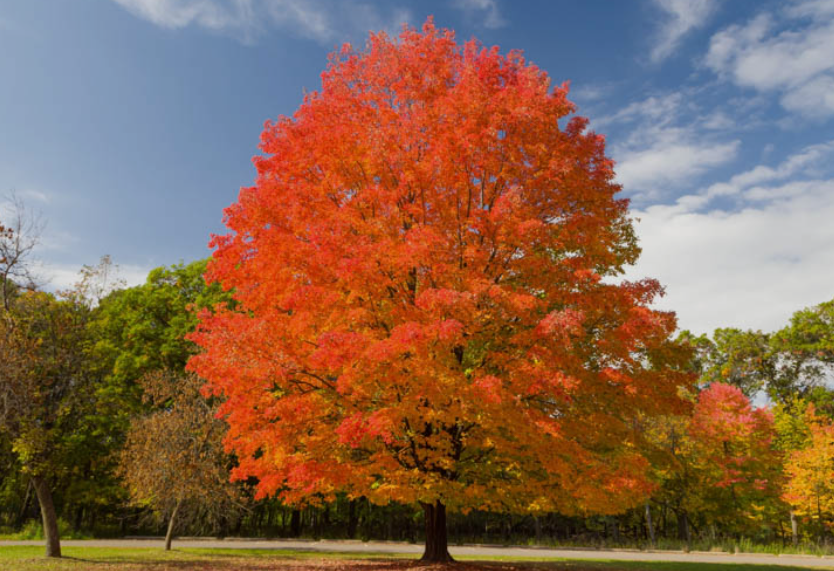
The sugar maple is one of the best-loved trees in North America. It gives us maple syrup, some of the most dazzling fall color on Earth and a tough, beautiful hardwood used in everything from kitchen cabinets to basketball courts. If you have ever admired a hillside of orange and scarlet leaves in New England in October, you were almost certainly looking at sugar maples.
This tall, long-lived shade tree grows wild across the northeastern United States, the Great Lakes region and southeastern Canada. It can reach 60 to 80 feet tall, sometimes taller, and many trees live for 300 years or more. Its leaf is so closely tied to Canada that a stylized maple leaf sits at the center of the Canadian flag.
Sugar maple is the state tree of New York, Vermont, West Virginia and Wisconsin. It is also one of the most planted shade trees in cooler parts of North America, prized for its dense canopy and reliable fall show.
Botanical Classification
The sugar maple belongs to the maple group, a large family of trees and shrubs with roughly 125 to 150 species worldwide. Maples were once placed in their own plant family but are now grouped within the soapberry family, alongside relatives such as horse chestnut and lychee.
Within the maples, sugar maple belongs to a small group of closely related trees often called hard maples. These include black maple of the Midwest, Florida maple of the Southeast and bigtooth maple of the American West. They share similar leaves, sweet sap and dense, heavy wood.
Brief History
Native Americans were tapping sugar maples long before Europeans arrived. Nations such as the Haudenosaunee and the Anishinaabe cut slashes in the bark each spring, collected the sap and concentrated it by boiling or by letting it freeze and removing the ice. The result was maple sugar, a staple food and trade item that could be stored for months.
European settlers learned the practice and made maple sugar their main sweetener in many northern areas, since cane sugar was expensive and imported. Over time, metal buckets, wooden sugarhouses and large flat evaporator pans replaced earlier methods. Today, many large producers collect sap through networks of plastic tubing that run from tree to tree.
Canada now produces roughly three-quarters of the world’s maple syrup, most of it in Quebec. In the United States, Vermont leads production, followed by New York, Maine and Wisconsin.
Identifying Characteristics
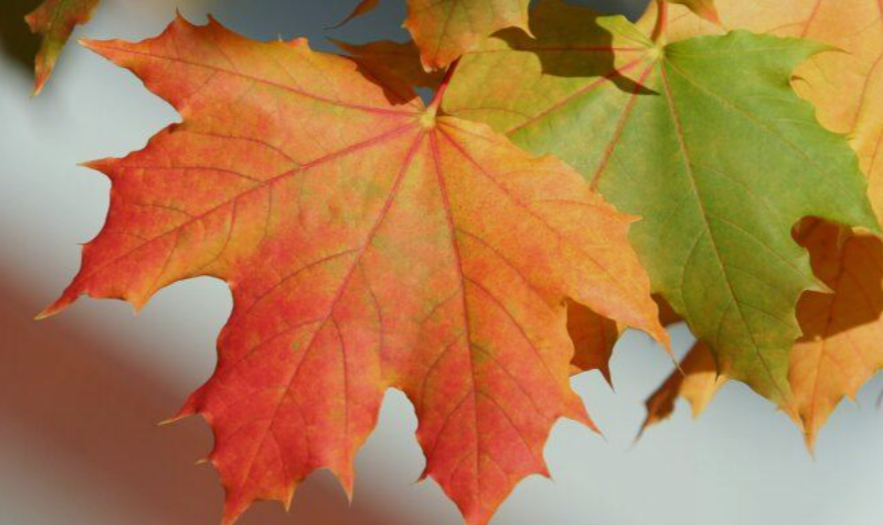
The easiest way to recognize a sugar maple is by its leaves. They are 3 to 6 inches wide with five lobes separated by smooth, rounded gaps. The edges have only a few large, wavy points and no fine teeth, which helps separate sugar maple from red and silver maples. The leaves are medium green on top and paler underneath.
Like all maples, the sugar maple has opposite branching, meaning its leaves, buds and twigs grow in pairs across from each other. Its winter buds are brown, slender and sharply pointed. Its seeds form in pairs of winged samaras joined in a U shape, and they ripen in early fall before spinning to the ground.
The bark of a young tree is smooth and gray. As the tree ages, the bark becomes darker and breaks into long, rough, vertical plates that sometimes curl outward at the edges. A mature sugar maple has a dense, rounded or oval crown that casts deep shade.
People often confuse sugar maple with Norway maple, a European tree widely planted along streets. A simple test is to snap a leaf stalk. Norway maple oozes milky white sap, while sugar maple sap is clear. Norway maple leaves are also usually wider and turn yellow in fall instead of orange and red.
Fall Color
Sugar maple is famous for one of the finest fall displays of any tree. Its leaves turn bright yellow, glowing orange and deep red, and a single tree can show all three colors at once. The show usually peaks in late September through mid-October in the North, and later farther south.
The best color comes after a fall of sunny days and cool, crisp nights. Those conditions trap sugars in the leaves, which the tree turns into red pigments. Drought, an unusually warm autumn or early frost can dull the color in some years.
Maple Syrup
Sugar maple sap is sweeter than the sap of almost any other maple, which is why it is the main tree tapped for syrup. Fresh sap is clear, watery and only about 2% sugar. It takes about 40 gallons of sap to make 1 gallon of syrup, and most of that water has to be boiled away.
Sap flows best in late winter and early spring, when nights drop below freezing and days warm to around 40°F. These swings in temperature build pressure inside the tree and push sap out of a tap hole. The season usually lasts four to six weeks.
A tree should be at least 10 to 12 inches across before it is tapped. A single tap in a healthy tree typically yields around 10 gallons of sap a season, enough for about a quart of syrup. Tapping, done properly, does not harm a healthy tree, and many trees are tapped for more than a century.
Maple syrup is sorted into grades by color and flavor, from light golden syrup with a delicate taste to very dark syrup with a strong, robust flavor. Lighter syrup usually comes early in the season and darker syrup later. Beyond syrup, sap is also boiled into maple sugar, maple cream and maple candy.
Wood and Other Uses
Sugar maple produces one of the hardest and most valuable woods in North America. Woodworkers call it hard maple or rock maple. It is pale, fine-grained and very strong, which makes it ideal for flooring, cabinets, furniture and cutting boards.
Its toughness has earned it a place in sports. Many basketball courts and bowling alleys are made of maple, and so are bowling pins and many baseball bats. Some trees produce unusual patterns known as bird’s-eye and curly maple, which are highly prized for fine furniture and musical instruments.
Sugar maple is also important to wildlife. Squirrels, chipmunks and birds eat its seeds. Deer, moose and snowshoe hares browse its twigs and buds, and many songbirds nest in its branches.
Landscape Uses
Sugar maple makes an outstanding shade tree for large yards, parks, campuses and rural roadsides. Its dense canopy can cool a house in summer, and its fall color adds a seasonal highlight few trees can match. It also suits wooded properties where it can grow among oaks, beeches and other hardwoods.
Because it grows large and casts deep shade, it is best planted where it has room to spread. It is not a good fit for narrow city sidewalks, small front yards or areas near power lines. Grass often struggles under a mature sugar maple because of the shade and shallow roots.
Growing Considerations
Sugar maple grows best in cool climates and is hardy from about USDA zone 3 to zone 8. It performs best in the northern half of the United States and in southern Canada. In hotter, drier regions, it often suffers from leaf scorch and slow growth.
It prefers full sun to partial shade and deep, moist, well-drained soil that is slightly acidic. It does not like heavy clay, soggy ground or very dry sites. Young trees benefit from regular watering during dry spells for their first few years.
Sugar maple grows at a slow to moderate rate, often about a foot a year once established. It is sensitive to road salt, soil compaction and pavement over its roots, which is why it often declines along busy streets. Mulching under the canopy and keeping lawn mowers and cars away from the trunk help protect its shallow roots.
Planting is best done in early spring or fall. Dig a hole wider than the root ball but no deeper, and keep the root flare at or slightly above ground level. Deep planting and piled-up mulch against the trunk can lead to girdling roots that slowly choke the tree.
Common Problems
Sugar maple is long-lived but faces several challenges. Leaf scorch, where leaf edges turn brown in hot, dry weather, is common in urban or southern sites. Verticillium wilt, a soil-borne fungus, can cause branches to wilt and die back suddenly.
Insects such as the Asian longhorned beetle, an invasive pest, can kill maples by tunneling into the wood, and infested areas in the Northeast have lost many trees. Tar spot, a fungus that causes black spots on leaves, is mostly cosmetic. In forests, invasive Norway maple can crowd out young sugar maples, and climate change is expected to shift where the tree grows best.
Popular Sugar Maple Cultivars
Several cultivars have been selected for better heat tolerance and garden performance. Green Mountain has thick, dark green leaves that resist scorching and is popular in the Midwest. Legacy is known for its tolerance of heat and drought, and Fall Fiesta offers glossy leaves and bright orange and red fall color.
Commemoration colors early in fall and holds up well to leaf damage. Bonfire turns brilliant red and grows faster than many sugar maples. For narrow spaces, Apollo forms a slender, columnar shape that takes up far less room than the species.
Frequently Asked Questions
How long does a sugar maple live? Sugar maples commonly live 200 to 300 years, and some reach 400 years in good conditions.
How fast does a sugar maple grow? It typically grows about 1 foot a year, slower in poor soil and faster in rich, moist ground.
Can you tap other maples for syrup? Yes. Red, silver, black and even boxelder maples can be tapped, but their sap is usually less sweet, so it takes more sap to make the same amount of syrup.
How can you tell a sugar maple from a red maple? Sugar maple leaves have smooth edges with a few large points, while red maple leaves have toothed edges and red stalks. Red maple also has red flowers in late winter.
Is sugar maple messy? It drops leaves in fall and seeds in early autumn, but it is generally considered a tidy tree compared with silver maple or boxelder.
